Article Read Time - 9 Mins
How to Prevent Hair Thinning: Causes & Solutions
By Nabeel Ahmed
Table of Contents
Your cart
Spend £30.00 more for Free Economy Delivery
You qualify for Free Economy Delivery
You Might Also Like

Moisturising Silky Hairspray For Hair Extensions

Hair Extension Heat Protection Spray

Hair Extension Hanger and Carrier


Subtotal
£0.00 GBP
We now ship 7 days a week! Next Day Delivery available every day

You're about to be redirected to our Trade website. Please confirm if you'd like to proceed.
Proceed to Trade Website
Article Read Time - 9 Mins
Table of Contents
There's nothing more disheartening than noticing your once-thick hair slowly thinning out. Whether it's linked to stress, hormonal changes, genetics, nutritional issues, or damage from excessive styling, thinning hair can feel like a losing battle.
But fear not: there are practical steps you can take to help prevent further thinning, as well as ways to add volume right away, even if you find that your mane isn't as thick as it used to be.
At Cliphair, we've been helping customers with hair solutions since 2007. We're not doctors. However, we do know a lot about styling, care routines, and extensions that work for thinner hair.
Hair naturally sheds every day as part of its normal growth cycle. Lost hairs are routinely replaced with new growth.
Hair thinning, however, is something different. It occurs when shedding increases, new growth slows down, or individual strands become finer over time.
If you've been asking yourself lately, "why is my hair thinning?", the answer could be genetics, at least to some extent.
Pattern thinning often runs in families. For women, it doesn't tend to manifest as a receding hairline. Instead, you might simply notice your parting becoming wider or your overall hair density decreasing.
Hormonal shifts can play a big role, too. By this, we're referring to such events as pregnancy and the months after giving birth (postpartum shedding), and the changes that come with menopause.
Many women notice extra shedding a few months after giving birth, which often settles as hormone levels return to normal. If you're experiencing this, our guide to fixing hair loss after pregnancy provides useful practical tips.
Great numbers of women are also curious about how to reverse thinning hair after the menopause. Thinning related to this stage of life often develops gradually, with falling oestrogen levels impacting on the hair growth cycle.
Of course, the effects of natural ageing can never be completely stopped. However, if you combine good nutrition with volumising styling techniques, you can be well-placed to ensure your hair looks as full as possible.
Are you experiencing hair loss at a younger age? In that case, our guide to hair loss in your twenties may be helpful, as it explores some of the key things you need to know.
The health of your hair depends greatly on your body getting the nutrients it needs.
What deficiency causes hair thinning? There are quite a few contenders for this particular title, including:
However, while nutrient deficiencies can be a factor in increased shedding for some people, they're only one possible cause.
So, it's important not to self-diagnose. If you do think a deficiency may be affecting your hair, it's worth speaking with your GP about it. They can advise whether blood tests are appropriate and recommend treatment if needed.
Another common question is, "does stress cause hair thinning?"
To this, we can answer with a "yes". Periods of physical or emotional stress can trigger temporary shedding after the stressful event. This is known as telogen effluvium, and the good news is that the hair usually grows back on its own as the body recovers.
Various everyday habits can also contribute to unnecessary hair strain or breakage. These include:
Tight hairstyles, for example, create traction that can damage follicles over time.
It's worth noting that despite perceptions to the contrary, washing your hair "too often" isn't a direct cause of hair thinning or permanent follicle damage. The loose hair that you may see in the shower has already naturally detached from its root during its normal growth cycle.
However, what is true is that harsh over-washing can strip natural oils. This can then lead to dry, brittle strands and hair breakage.
"Can wearing a hat cause hair thinning?" might be something you have argued with your friends about down the years.
So, let's gently debunk that myth: no, on its own, the simple act of wearing a hat does not cause anyone's hair to thin.
The wearing of a hat can become an issue for the hair, though, if it fits extremely tightly and creates ongoing friction or traction around the hairline.
But of course, the average person probably doesn't wear too tight a hat. So, in most cases, yours will be perfectly safe to wear and won't imperil your hair growth.
Curious about what other myths might be holding back your hair growth journey? Explore this myth-busting guide for more insights.
A certain amount of hair shedding is completely normal; the typical daily amount is around 50 to 100 hairs.
If, though, you're losing significantly more hair than this, you're seeing bald patches, or it's otherwise worrying you, we would urge you to speak to your GP, a dermatologist, or a trichologist. Such a professional will be able to rule out any underlying issues.
Here at Cliphair, we're experts in extensions and haircare, and we're happy to advise on these subjects. We aren't a medical or wider healthcare brand, so we can't diagnose medical causes of hair thinning.
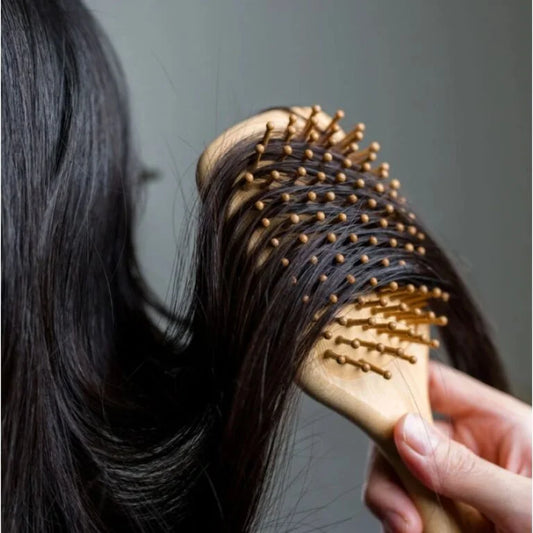
Be kind to your hair while detangling, by starting from the ends and working upwards. A good detangling brush, such as Cliphair's own Detangling Hairbrush, will enable you to glide through knots with less pulling. This makes our brush, also known as "The Wet One", especially useful for both natural hair and extensions.
You can also give your hair an easier ride by switching to a silk pillowcase, which will help reduce friction overnight. Also take care to avoid tight hairstyles that pull.
Are you noticing shorter broken hairs around your face? If that's a "yes", check out our guide to hair breakage around the face, which explains the causes and how to help prevent further damage.
Healthy-looking hair starts with gentle cleansing. For this task, make sure you seek out products that are free from sulphates, silicones, and parabens.
Our own Deep Moisture Shampoo, Deep Moisture Conditioner, and Deep Moisture Hair Mask here at Cliphair help replenish the hair's moisture. They also go a long way to keeping both natural hair and extensions soft and manageable.
If you're thinking about changing your colour at home, the safest course of action is to stick to darkening or toning your hair, and to steer well clear of "DIY" bleaching. Significant lightening is best left to a professional colourist.
Browse our complete hair care collection for products designed to support the healthy appearance of hair.
Limit the use of hot tools on your natural hair and extensions, and always use a heat protectant spray. It also helps to let your hair air dry whenever possible.
Are you trying to avoid heat altogether? In that case, you'll probably appreciate the easy styling ideas provided by our guide to heatless overnight curls.
Gentle scalp massages can help boost circulation. Be sure to keep your scalp clean, stay hydrated, and eat a balanced diet with enough protein. You might also consider using lightweight oils such as rosemary, peppermint, or tea tree if they suit your skin.
Everyone's scalp is different, so don't forget to patch test any new product first.
For more ideas, read our article on the right scalp care routine for healthy hair extensions.
The right haircut can make an enormous difference. This is why it can be a good idea to ask your stylist for soft layers that add movement.
Many such professionals also recommend blow drying with a round brush for root lift, as well as the use of volumising mousse and texturising sprays.
We've previously written about the various easy styling tricks that you might try to add volume and thickness to your hair.
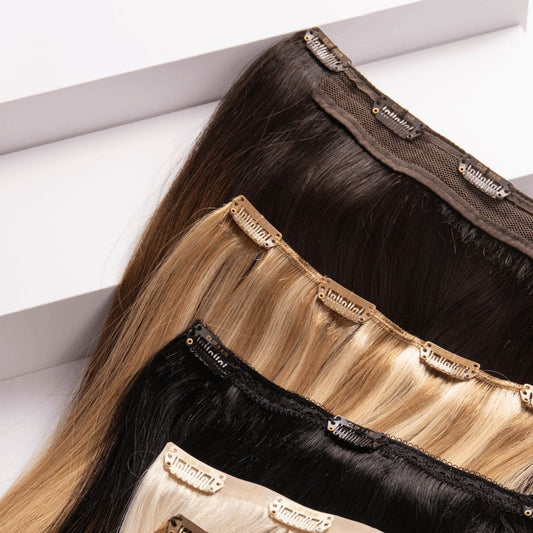
When it comes to pulling off instant fullness with zero longer-term commitment, you'll struggle to find a solution as quick and convenient as clip-in hair extensions.
Cliphair's own extensions are made from ethically sourced, 100% Remy human hair. This means if you place your trust in this brand's offerings, you can count on them blending convincingly with your own hair, including through their natural movement and shine.
Clip-ins like ours are suitable for hair from around four inches long, provided that there's sufficient hair to conceal the clips comfortably.
Could you do with help choosing colours? Remember that our real experts (not bots) offer free colour matching advice.
For more inspiration, read our article on the hair extension types that are best suited to fine or thin hair. We've even got suggestions of five gorgeous hairstyles for thin hair that you might want to try.
Permanent extensions can create beautifully full hair without the need for daily clipping. They aren't suitable for everyone, though, and professional consultation is essential.
Tape-in extensions allow for lightweight and natural-looking volume. Cliphair offers:
Tape-ins should always be professionally fitted and professionally removed.
Do you desire longer-term fullness? With that in mind, you might be drawn towards professionally fitted wefts and nano systems.
Cliphair offers possibilities such as:
As with the tape-in options, it is crucial to emphasise that these methods should always be fitted and maintained by a trained professional.
A word of caution: we don't recommend having permanent extensions fitted on hair that's actively shedding at the root. Adding extra weight while significant shedding is ongoing can increase stress on fragile hair.
Instead, we would urge you to first speak to your GP or dermatologist, who'll be able to help you understand what's causing your hair thinning.
Once your hair is stable, a specialist will be able to advise on the suitability (or otherwise) of permanent extensions for your needs.
Our guide to extension types for fine and thin hair can also help you compare your options.
Hair thinning can happen for a variety of reasons, such as genetics, hormonal changes, stress, nutrient deficiencies, ageing, and certain hairstyles that place repeated tension on the hair. If you’re experiencing sudden or severe thinning, it’s worth speaking to your GP.
Yes, for some people, iron and/or vitamin B12 deficiencies may contribute to increased shedding. However, these are only two possible causes of thinning hair. So, you shouldn’t self-diagnose; instead, get your levels checked by a doctor.
The terms “hair thinning” and “hair loss” are sometimes used interchangeably, but they aren’t always the same. “Hair thinning” is normally used in reference to the hair becoming gradually less dense. “Hair loss”, meanwhile, is the broader of the two terms, and is likelier to be mentioned for instances of sudden shedding or patchy bald spots.
Extensions aren’t your only options for boosting your hair’s appearance of fullness. You could consider embracing a layered or blunt haircut, using volumising styling products, and/or blow-drying with a root lift. A root lift is a targeted styling product designed to elevate hair strands up and away from the scalp.
Wearing hair extensions doesn’t have to make your hair thinning worse, as long as you choose the right ones and care for them correctly. For example, clip-ins are removable and low-risk. Permanent extensions, on the other hand, need to be professionally fitted and might not be suitable while your hair is actively shedding from the root.
You can’t completely stop age-related changes. You can, however, support your hair by eating a balanced diet, looking after your scalp, minimising unnecessary heat and chemical damage, avoiding excessive tension, and choosing styling techniques that create natural-looking volume. Extensions can help restore confidence while you address underlying factors.
Looking for salon-worthy hair without breaking the bank? At Cliphair, we’re here to help with high-quality clip in hair extensions for quick transformations and permanent hair extensions for long-lasting length or volume, all made from 100% Remy Human Hair. Extensions need special care and maintenance to preserve their quality, which is why we have our own hydrating haircare products, designed to keep your hair soft and tangle-free.
Need to find your closest shade match? Browse our full range of human hair extensions in over 60 shades or check out our FREE Express Colour Match Service to get a great blend with your natural hair.
 Ethically Sourced
 Outstanding Reviews
 Cliphair Rewards
 Free delivery & returns
 Buy now pay later